
08 Feb 2026
AR for HVAC: Driving First-Time Fix with Precision
By Atul Vasudev A : Director of Engineering,
In the high-stakes world of enterprise operations, the most expensive sound is silence—the silence of a downed HVAC system in a data center, a halted production line, or a non-functional climate control unit in a surgical suite. For years, maintenance teams have been "drowning in tools that offer lagging indicators," relying on paper manuals or 2D tablets that provide data but no real foresight.
As we move through 2026, the industry is shifting from "reactive panic to predictive power". The key to this transition? Sub-centimeter AR alignment. In the HVAC and maintenance sector, "close enough" is the enemy of efficiency. We are no longer just showing technicians where a part is; we are providing the precision needed to ensure a First-Time Fix (FTF).
The Strategic Problem: The Cost of Being "Nearly" Right
For organizations in Enterprise Ops and Manufacturing, decisions are currently slow and manual. When a technician arrives on-site for an HVAC repair, they often face "paralysis from dashboard overload". They have the sensor data, the service history, and the schematics, but they lack a single source of truth that connects that data to the physical machine in front of them.
Why 2D Data Fails the Maintenance Mission
- Manual Analysis: Technicians must mentally translate a 2D diagram onto a complex 3D machine, leading to "manual analysis" errors.
- Lagging Indicators: Traditional tools tell you what was wrong, not what is happening in real-time spatial context.
- Physical Revenue Leakage: In vertical operations, the lack of foresight results in downtime and inefficient forecasting.
The "First-Time Fix" rate is the holy grail of maintenance. Every time a technician has to return because they brought the wrong part or misidentified a valve, the cost of that repair skyrockets, directly impacting the company’s valuation.
The Noxvision Promise: Foresight Through Precision
Noxvision wins by converting raw data into foresight. In HVAC maintenance, this foresight is powered by the ±1cm Rule. This benchmark ensures that virtual overlays—whether they are thermal heat maps, pressure indicators, or step-by-step repair guides—align with sub-centimeter accuracy to the physical assets.
1. Eliminating "Guesswork" in Complex Systems
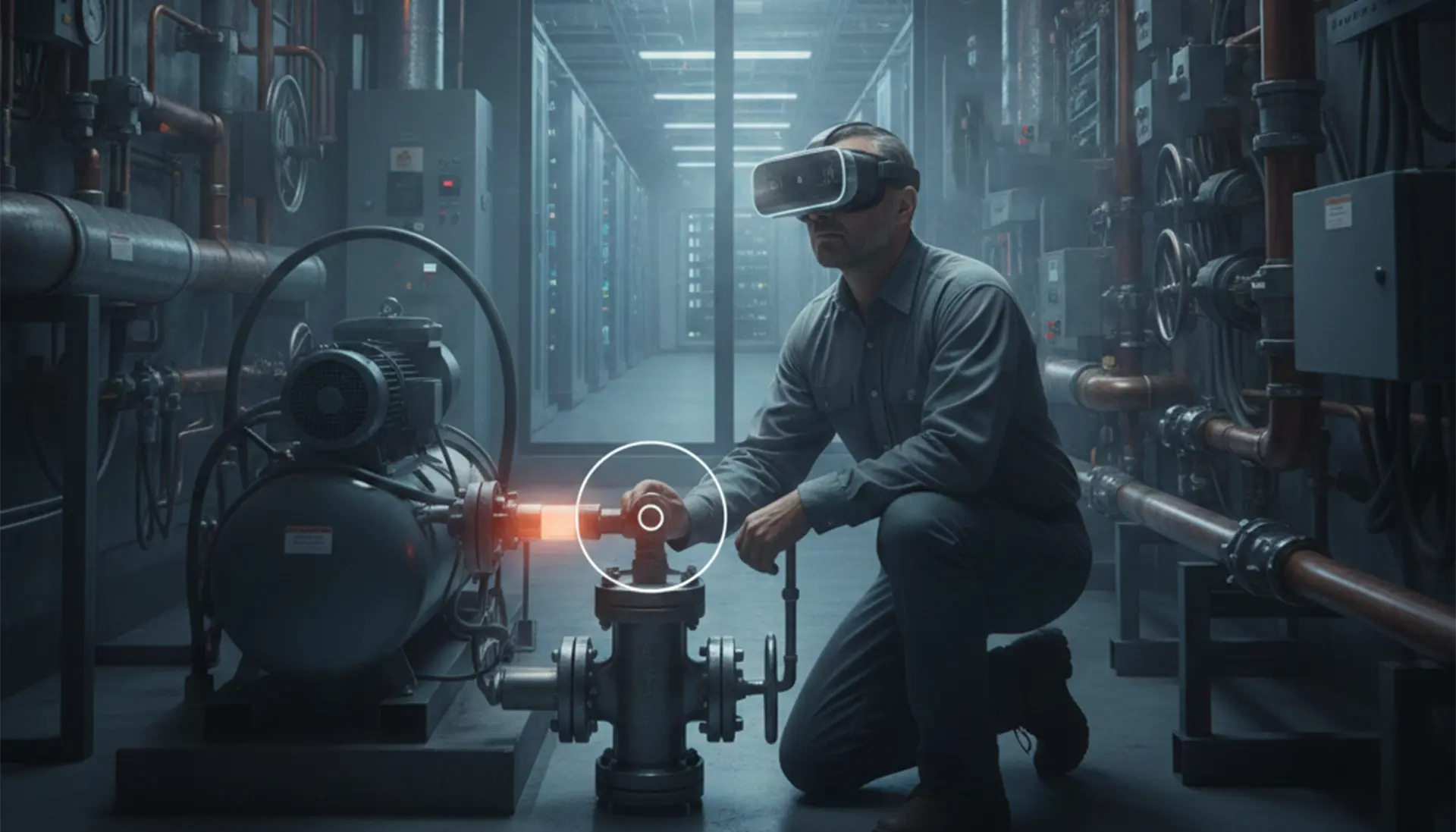
HVAC units are a maze of copper piping, electrical conduits, and sensitive sensors. A technician using standard AR might see a floating arrow pointing "somewhere near" a compressor. A technician using NoxSDK sees a sub-centimeter overlay that highlights the exact bolt that needs tightening.
- Visual + Predictive Intelligence: We prevent the physical costs of being wrong by ensuring the AR "fix" matches the physical reality.
- Precision Targeting: This level of accuracy drives specific business outcomes, including faster sales cycles for service contracts and higher CLV from satisfied enterprise clients.
2. The "Anti-Dashboard" Experience for Technicians
Our persona spotlight, X, is tired of "more data". X wants decisions. In the field, this means:
- Clear Insights (Not Raw Data): Instead of a table of pressure readings, the technician sees a virtual red glow on the specific pipe that is over-pressurized.
- AI Recommendations: The system doesn't just show the problem; it provides AR-guided steps to resolve it based on real-time diagnostics.
Scaling AR-Driven Maintenance Across High-Value B2B Industries
While HVAC is the primary use case, the need for sub-centimeter maintenance guides spans all High-Value B2B Segments.
Cluster 1: Tech & Strategy (The Brain)
- SaaS Leaders: For companies managing server farms, HVAC uptime is non-negotiable. They use Noxvision to accelerate GTM velocity by ensuring their infrastructure is always scale-ready.
- Enterprise Ops: These leaders demand efficiency and alignment across departments. Predictive intelligence for operations turns maintenance from a cost center into a competitive advantage.
Cluster 2: Vertical Operators (The Body)
- Manufacturing & Supply Chain: Plant heads use sub-centimeter AR to reduce downtime. When every minute of a stoppage costs thousands, the "foresight" to fix it right the first time is invaluable.
Cluster 3: Regulated Scale (The Infrastructure)
- Healthcare Ops: Hospital admins face cost leakage and poor operational visibility. In a hospital, an HVAC failure in a sterile environment isn't just an expense; it's a compliance crisis.
Technical Deep Dive: Achieving Sub-Centimeter FTF
How does the NoxSDK maintain the precision required for a First-Time Fix in the chaotic environment of a mechanical room?
1. Handling Textured and Featureless Assets
Mechanical rooms are often dark, cramped, and filled with shiny or untextured surfaces that "break" standard AR.
- Tracking the "Untrackable": Noxvision handles textured industrial assets where others fail by using hybrid SLAM architecture that combines native device stability with proprietary visual feature mapping.
- Scoring Engine: Before a technician begins a repair, the system evaluates the "Data Maturity" of the environment. If the score is below our 32/45 threshold, the system prompts the technician to calibrate, ensuring that the repair guide is never "guessing".
2. Secure, Scalable Platform
For X, security is a "must-have". Our platform ensures that sensitive infrastructure data is handled within a secure, scalable framework, allowing for "board-ready insights" on maintenance efficiency across the entire enterprise.