
20 Jan 2026
Hands-Free Industrial Training on Quest 3
By Atul Vasudev A : Director of Engineering,
The Meta Quest 3 has redefined the "Gold Standard" for standalone enterprise headsets. With its advanced pancake lenses and Snapdragon XR2 Gen 2 chipset, it provides the visual fidelity required for detailed industrial work. However, the true breakthrough for the factory floor isn't the display—it's the transition to hands-free, controller-less interaction.
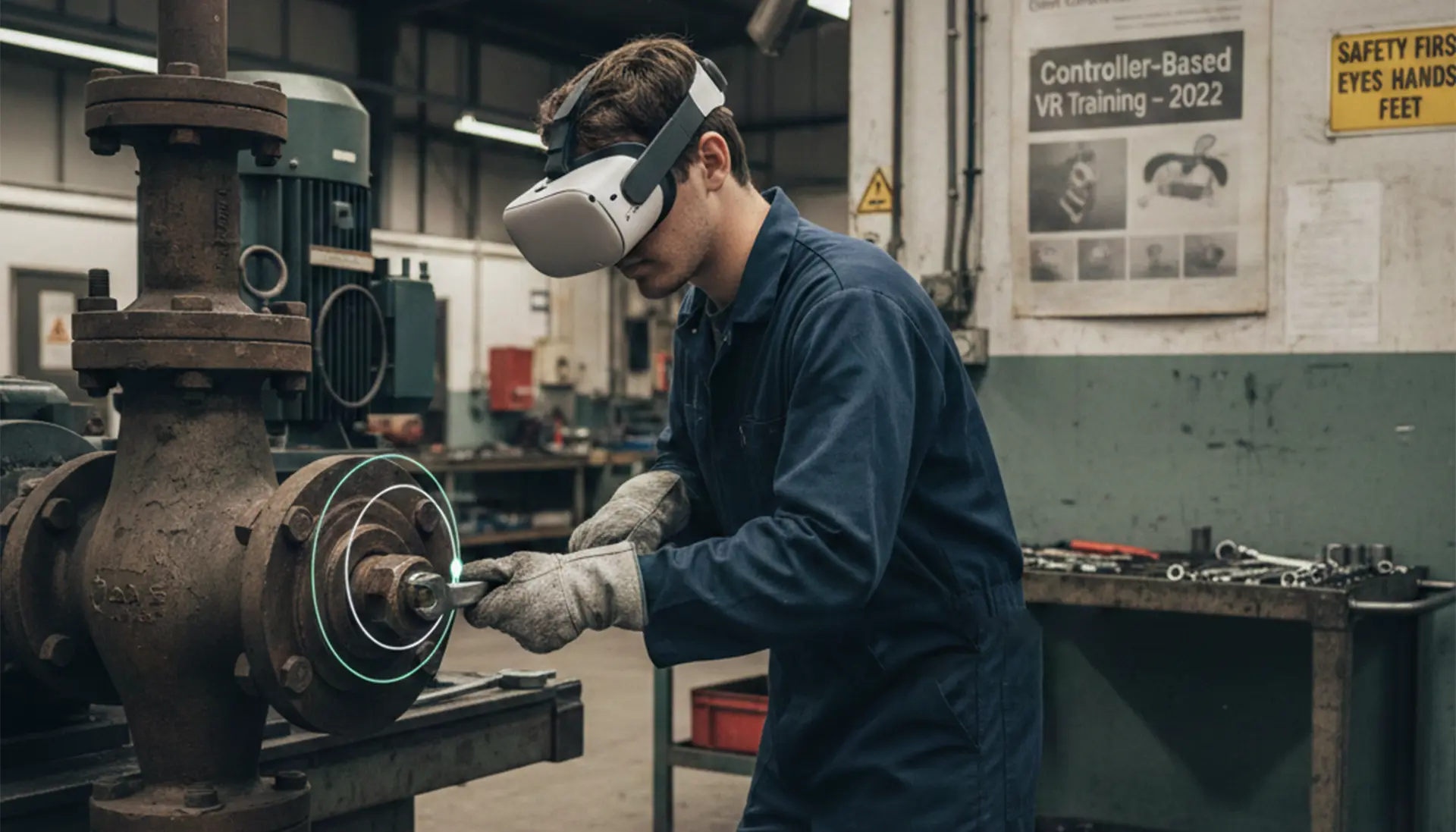
By utilizing the NoxVision API, enterprises can move beyond simple hand-tracking and enter the realm of Spatial Object Intelligence. This allows trainees to use their actual hands to manipulate physical tools while receiving real-time AI-powered guidance.
1. The Power of "Hands-Free": Why Controllers are a Barrier to PMF
In an industrial setting, muscle memory is everything. Training a technician to use a VR controller to simulate a wrench-turn creates a cognitive "abstraction gap."
NoxVision’s API bridges this gap by enabling Natural Interaction Patterns. By leveraging the Quest 3’s high-frequency hand-tracking sensors, NoxVision provides a 6DoF (Six Degrees of Freedom) spatial layer. This allows the software to recognize not just where the hand is, but how it is interacting with a specific Photogrammetry-defined entity. When a trainee reaches for a real-world valve, NoxVision identifies the object and confirms the hand placement with sub-millimeter precision.
Key Industrial Benefits:
- Natural Muscle Memory: Trainees learn the exact physical gestures required for the job.
- Safety First: Hands-free training allows for "Stress-Testing" without the risk of dropping expensive controllers or real-world tools.
- Reduced TTHW: (Time to Hello World) Trainees don't need to learn a button layout; they already know how to use their hands.
2. Technical Integration: Implementing the NoxVision API
For Dev Leads, the transition to NoxVision on Quest 3 is designed for Minimal Friction. The SDK is fully compatible with OpenXR and the Meta Interaction SDK.
Step-by-Step API Implementation:
- Initialize the Spatial Anchor: Use NoxAPI.Initialize(Quest3_Config) to sync the NoxVision AI engine with the Quest’s Passthrough camera feed.
- Define the Object Entity: Instead of generic mesh tracking, NoxVision allows you to "Inject" a Photogrammetry model.
- Map Gesture Events: Use the Nox Gesture Library to trigger training events.
· Example: If the trainee performs a "Pinch and Rotate" gesture on a specific bolt, the API triggers a Success_Event.
Case Study: High-Voltage Maintenance Training
A global energy provider transitioned from "Controller-based VR" to NoxVision Hands-Free on Quest 3.
- The Problem: Technicians were "gaming" the VR training using controller buttons but failing real-world safety tests.
- The Solution: NoxVision required them to use real-world insulated gloves and perform the actual "Two-Hand Safety Rule" gestures.
- The Result: A 45% increase in safety compliance and a 20% reduction in onboarding time.
Conclusion: The Future of the Hands-Free Workforce
In 2026, the Meta Quest 3 isn't just a headset; it’s an industrial tool. By integrating the NoxVision API, you are removing the last barrier between digital learning and physical mastery. The future of training is hands-free, AI-guided, and precision-engineered.