
23 Feb 2026
The ±1cm Rule: Why Sub-Centimeter AR Matters
By Atul Vasudev A : Director of Engineering,
In the industrial landscape of 2026, the era of "visual overlays" has officially ended. We have moved beyond the novelty of seeing a 3D model in a headset; we are now in the era of Spatial Decision Intelligence. As an "Anti-Dashboard" Executive, I’ve seen organizations drowning in tools that offer lagging indicators. They have dashboards everywhere, but clarity nowhere.
The industry has reached a tipping point where "close enough" is no longer an option. This is where the ±1cm Rule comes in. It is the new global benchmark for accuracy, reliability, and mission-critical ROI. If your AR solution cannot guarantee sub-centimeter alignment, it is simply another source of "dashboard fatigue".
The Context: Why the Centimeter is the New Mile
For years, AR was treated as a tool for "training" or "visualizing". A drift of 5cm or 10cm was acceptable because the goal was merely to show a technician where a valve was located. But in 2026, our GTM strategy targets leaders who are actively seeking to bridge the gap between raw data and decision intelligence.
In a mission-critical environment—such as a manufacturing plant or a smart city infrastructure project — a 5cm error is the difference between a successful installation and a $50,000 equipment collision.
The Problem: Dashboards Everywhere, Clarity Nowhere
Organizations are drowning in tools that offer lagging indicators. Decisions are currently slow, reactive, and manual. When an AR system drifts, it creates "clutter" and user distrust. The technician stops looking at the AR and goes back to the manual. This is "reactive panic".
The Noxvision Promise: Converting Data into Foresight
Noxvision wins by converting raw spatial data into foresight to enable faster product, pricing, and GTM decisions. We move organizations from reactive panic to predictive power. The ±1cm Rule is the technical foundation of this promise.
Defining the ±1cm Rule: The Physics of Precision
The ±1cm Rule isn't just a marketing slogan; it’s a strict technical requirement for High-Value B2B Segments. It refers to the maximum allowable deviation (drift) between a virtual anchor and its real-world physical counterpart over a sustained period of operation.
1. Pose Estimation and Drift Compensation
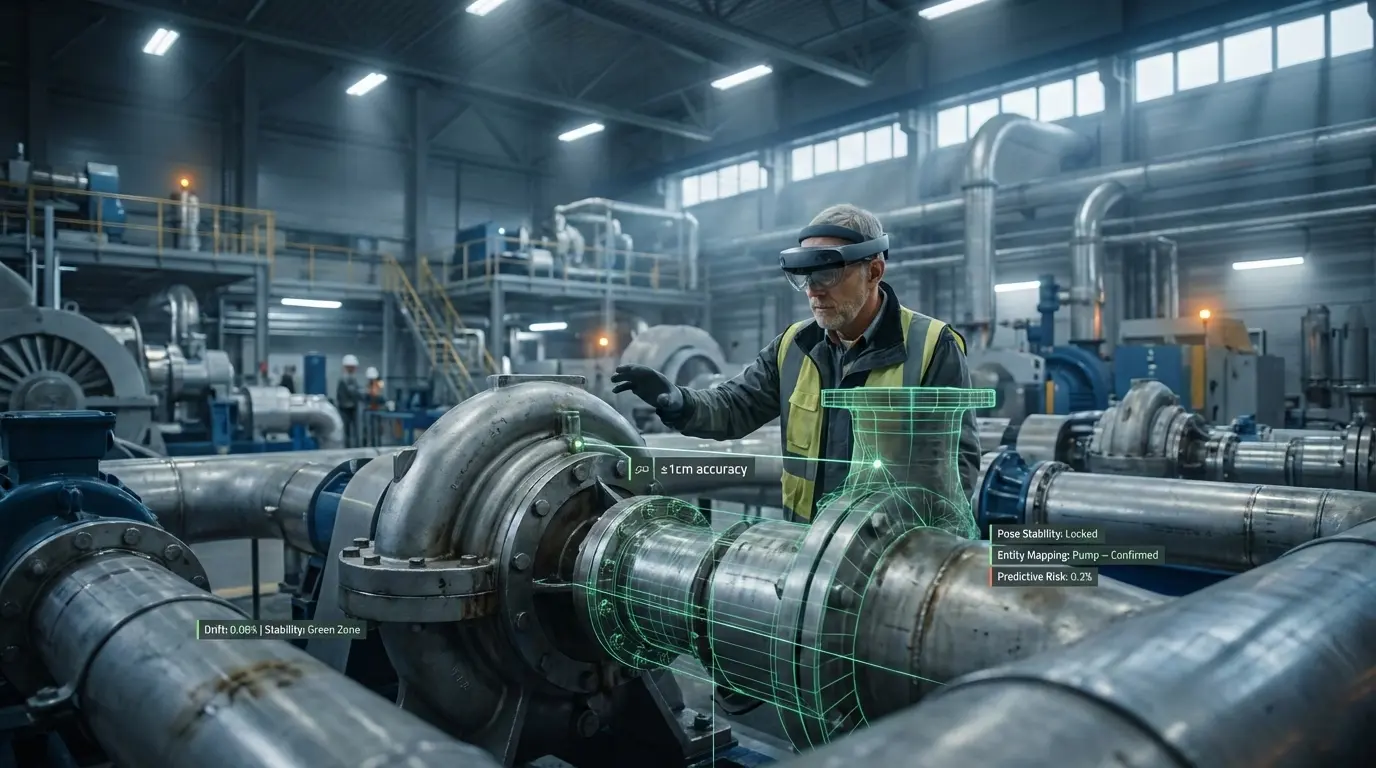
To achieve sub-centimeter accuracy, the NoxSDK utilizes a proprietary Hybrid SLAM Architecture. While native tools like ARCore or ARKit provide a baseline for motion tracking, they are often insufficient for textured industrial assets where lighting is inconsistent and surfaces are metallic.
Our architecture performs NLP-informed Bidirectional Probing. This means the system doesn't just "look" for points; it probes the semantic context of the environment. It understands that it is looking at a "pump" or a "conduit" and uses that semantic knowledge to correct pose estimation errors in real-time.
2. The ±1cm Benchmark vs. The Competition
| Metric | Standard AR (Competition) | Noxvision (NoxSDK) |
|---|---|---|
| Accuracy | ±5cm to ±10cm | ±1cm (Sub-centimeter) |
| Drift Rate | High (1-2% of distance) | Ultra-Low (<0.1%) |
| Tracking Stability | Jittery on shiny surfaces | Stable (Mission-Critical) |
| Business Outcome | Manual Verification Required | Predictive Power |
Why It Matters for SaaS Leaders
If you are a Data-Driven SaaS Leader scaling ARR or preparing for a Series B/C round, you know that the cost of "guessing" impacts your valuation directly.
Strategic Implication: Valuing Accuracy
For SaaS Leaders, decisions are currently reactive because they face paralysis from dashboard overload. They need board-ready insights. If your product depends on spatial data, your valuation is tied to the integrity of that data.
- Faster Sales Cycles: When you can prove ±1cm accuracy, you remove the "technical doubt" that slows down enterprise sales.
- Higher CLV: Scale-ready customers stay longer when the tool works exactly as promised every single time.
- Lower Support Costs: Precision eliminates the "clutter" that leads to user error and support tickets.
Industry Fit: Scaling the ±1cm Rule
The need for precision varies across our 7 High-Value B2B Segments.
Cluster 1: Tech & Strategy (The Brain)
- SaaS Leaders: Need accuracy to validate their digital twins and ensure their platform is the "Single Source of Truth".
- Marketing & Growth: Use precision to prove attribution and ROI. If an AR marketing experience is misaligned, the brand awareness is negative.
Cluster 2: Vertical Operators (The Body)
- Retail & E-commerce: Use AR for inventory management. A 5cm error in warehouse slotting can lead to physical revenue leakage.
- Manufacturing & Supply Chain: This is where the rule is most critical. Downtime and inefficient forecasting are the primary pains.
Cluster 3: Regulated Scale (The Infrastructure)
- Healthcare Ops: Non-clinical operations require compliance-friendly intelligence.
- Smart City / Infra: Large-scale projects involve complex data sets that slow down decision-making. Precision at scale is the only way to manage these projects effectively.
The Technical Deep Dive: Achieving Sub-Centimeter Stability
How does NoxSDK handle textured industrial assets where others fail?
1. Tracking the "Untrackable"
Industrial environments are often "featureless" or have repeating patterns (like floor tiles or metal grates). Standard visual odometry fails here. Noxvision uses Visual + Predictive Intelligence to prevent the physical costs of being wrong.
- IMU Integration: We utilize advanced sensor fusion to maintain tracking even when the camera view is obstructed.
- Entity Mapping: We map industrial assets as Semantic Entities. The system knows what a "lathe" looks like and uses its known geometry to "snap" the AR overlay into ±1cm alignment.
2. The Scoring Engine
We do not treat all environmental data equally. Our scoring engine ranks the "Data Maturity" of a scene from 0-10.
- Threshold 32/45: We only deploy high-precision overlays when the environment meets a strict qualification threshold.
- Red Zone (<32): The system alerts the user to "nurture" the environment—improving lighting or adding anchors—before attempting mission-critical tasks.
- Green Zone (≥32): We pursue the task aggressively with full ±1cm confidence.